Monday, February 20, 2012

India's Infrastructure Debt Fund

India's Infrastructure Debt Fund

The RBI has given its permission to banks and non-banking financial companies NBFCs for setting up infrastructure debt funds in the form of NBFCs or mutual funds on September 23, 2011. This comes at a time when the Planning Commission has projected a huge investment requirement of the order of about $1 trillion in the Twelfth Plan (2012-17) for infrastructure projects.

SEBI also recently formulated a draft chapter VI-B, which on insertion in the existing Mutual Fund Regulations shall permit setting up of IDFs on this route by registered MFs as a scheme. The Board of SEBI said that they will announce the scheme separately after due process.

An IDF may be set up either as a trust or as a company. A trust based IDF would be a mutual fund that would issue units while a company based IDF would be a non-banking finance company (NBFC) that would issue bonds.

https://blogger.googleusercontent.com/img/b/R29vZ2xl/AVvXsEi27i7mQcSP-EXMkTGNB_zFAMARzaB-Q2QGJGbOZggUVOp5EdmI_Rl7AXtlMjSndocaNDwBGc-EQsRlJUe6FJkKijyFMeQxX5R0lNY155lygNzh5HDUqpBefu7G7xkFlK3THKBufKS51H0/s640/idf.jpg


The investors would primarily be domestic and off-shore institutional investors, especially Insurance and Pension Funds who have long term resources. Banks and FIs would only be allowed to invest as sponsors of an IDF.

IDF floated as MF
1.  Banks acting as sponsors to IDF-MFs would be subject to existing prudential limits including limits on investments in financial services companies and limits on CME.
2.  NBFC acting as sponsors to IDF-MF, they will be required to have minimum net owned funds (NOF) of Rs 300 crore, CRAR of 15 % ; and net NPA of less than 3.0% of net advances. Further, NBFCs should have been in existence for at least 5 years; earning profits for the last three years and their performance should be satisfactory.

IDF floated as NBFC 
Sponsors (Banks and NBFC-IFC) will have to contribute a minimum equity of 30.0 % and a maximum equity of 49.0% in IDF-NBFC.
1.      Banks acting as sponsor to IDF-NBFCs would be subject to existing prudential limits including limits on investments in financial services companies and limits on CME .
2.       NBFC acting as sponsor to IDF-NBFC Post investment in the IDF, the sponsor must maintain minimum CRAR and NOF prescribed for IFCs.
3.      Criteria for IDF-NBFC

i) The IDF must have NOF of Rs. 300 crore or above;

ii) The IDF should be assigned a minimum credit rating 'A' or equivalent of CRISIL, FITCH, CARE, ICRA or equivalent rating by any other accredited rating agencies;

iii) Tier II capital cannot exceed Tier I. Minimum CRAR should be 15% of risk weighted assets;

iv) The IDF shall invest only in PPP and post COD infrastructure projects which have completed at least one year of satisfactory commercial operation and are a party to a Tripartite Agreement with the concessionaire and the Project Authority for ensuring a compulsory buyout with termination payment;

v) For the purpose of computing capital adequacy of the IDF, bonds covering PPP and post COD projects in existence over a year of commercial operation shall be assigned a risk weight of 50%

The maximum exposure that an IDF can take to a borrower or a group of borrowers will be at 50% of its total capital funds. Additional exposure up to 10%would be allowed at the discretion of the Board of the IDF-NBFC.
Post-investment in the IDF-MF, the CRAR of the NBFC should not be less than that prescribed and it should continue to maintain the required level of NOF.

Positives and negatives of IDF NBFC
Positives:
1.  The NBFC structure may issue bonds in both Rupee and foreign currencies thus have less risk as compared to Mutual fund structure which can issue only Rupee denominated units
2.   This may help banks reduce dependence on takeout financing agencies and will take off the burden from the banks which are nearing their exposure limits to various sectors and companies
3.   The IDFs will also help accelerate the evolution of a secondary market for bonds which is presently lacking in sufficient depth. Thus the IDFs would enable sourcing of funds through alternate sources which would help in bridging the likely debt gap.

Negatives:
1.    IDF NBFC can invest only in PPP and post COD infrastructure projects which have completed at least one year of satisfactory commercial operation; this would make a large number of projects that are under moratorium and pure private projects ineligible for lending.
2.    Most power projects that take five years and more to complete may not be eligible for funding by IDFs.

IDF is surely an innovative way to bring new sources of both domestic and international investment into the marketplace and will help to close the growing funding gap

Monday, May 16, 2011

Delhi International Airport Ltd

DIAL is a joint venture consortium of Bangalore headquartered global Infrastructure major GMR Group (54%), Airports Authority of India (26%), Fraport & Eraman Malaysia (10% each). GMR is the lead member of the consortium; Fraport AG is the airport operator, Eraman Malaysia - the retail advisors.

In January 2006, the consortium was awarded the concession to operate, manage and develop the IGI Airport following an international competitive bidding process. DIAL entered in to Operations, Management and Development Agreement (OMDA) on April 4, 2006 with the AAI. The initial term of the concession is 30 years extendable by a further 30 years.
The development of IGI Airport is taking place under a phased Master Plan. As part of the first phase DIAL has already commissioned a new runway and domestic terminal at IGIA. In July 2010, DIAL commissioned a modern integrated passenger Terminal (Terminal 3).

The Delhi Airport is being developed on the following contractual structure:

Sunday, May 15, 2011

The Pecking Order ,Static trade off & signalling theory

The Pecking Order Theory

 The pecking order theory describes how firms raise capital. This theory says that firms are
driven by information asymmetries and transaction costs to use internally generated capital first before turning to more expensive sources of financing. Once their internal sources are used, then firms will use debt (where the information asymmetry problem is less severe)
first and then as a last resort equity.


The pecking order theory is able to explain why firms tend to depend on internal sources of funds and prefer debt to equity if external financing is required. Thus, a firm’s leverage is not driven by the trade-off theory, but it is simply the cumulative results of the firm’s attempts to mitigate information asymmetry.

As per Myer’s Pecking order theory firm will take debt in which they have to give least information to the market
Order
                                                 1.      Retained Earning
      2.      Private debt
      3.      Public debt
      4.      Equity


The Static Trade off theory

This theory deals with the cost of distress and positive effects of tax. According to this theory D/V is optimal when Marginal Benefit of tax shield are not greater than marginal cost of bankruptcy or
PV (Tax Shields) = PV (Expc Bankruptcy Costs)
Using High leverage in the capital structure cannot be explained.

Signalling theory –As per this theory by raising public debt companies provide signal to the market that there are many investors and project is good.

Friday, May 13, 2011

Take out Financing

Take out Financing

As per RBI notification (DBOD. No. BP. BC. 67 / 21.04.048/ 2002- 2003)

•      Take-out financing structure is essentially a mechanism designed to enable banks to avoid asset-liability maturity mismatches that may arise out of extending long tenor loans to infrastructure projects. Under the arrangements, banks financing the infrastructure projects will have an arrangement with IDFC or any other financial institution for transferring to the latter the outstanding in their books on a pre-determined basis. IDFC and SBI have devised different take-out financing structures to suit the requirements of various banks, addressing issues such as liquidity, asset-liability mismatches, limited availability of project appraisal skills, etc. They have also developed a Model Agreement that can be considered for use as a document for specific projects in conjunction with other project loan documents. The agreement between SBI and IDFC could provide a reference point for other banks to enter into somewhat similar arrangements with IDFC or other financial institutions.

 In simple words  It is a method of providing finance for long projects (say 15 years) by sanctioning medium-term loans (five-seven years). It involves an understanding that the loan will be taken out of the books of the financing bank within a pre-fixed period and taken over by another institution, thereby preventing any possible asset-liability mismatch, as most liabilities of banks are in the form of deposits with tenures of less than five years. 

 According to the Reserve Bank of India data, in financial year ended March 2009, Only. Around 7.4 per cent deposits had a maturity period of more than five years. After taking out the loan, the institution can off-load it to another bank or keep it.Although the concept has witnessed teething troubles, a revival is expected given that RBI is expected to allow tapping of external commercial borrowings for takeout
Financing.
 
•       Institution/bank financing the infrastructure projects will have an arrangement with any financial institution for transferring to the latter out standings in respect of such financing in their books on a pre-determined basis.
•       It help the banks in asset liability management since the financing of infrastructure is long term in nature against their short-term resources

Advantages
•       Infrastructure projects will face less financing difficulties arising from the downturns.
•       Incremental lending to infrastructure will provide additional liquidity in the system.        
        Borrowing capacity of project developers will increase and will enable them to participate in mega  projects
Prerequisite for takeout financing
•       A proper yield curve is a prerequisite for takeout financing to succeed.
•       Securitisation framework for selling of the project loans would need to be clarified.
Types of Take out Financing
  •  Unconditional take out finance -The unconditional take out finance involves the assumption of partial / full credit risk by the institution agreeing to take over the finance from the original lender  
  • Conditional take over: -In this scenario, the taking over institution would have stipulated certain conditions to be satisfied by the borrower before it is taken over from the lending institution. There is, therefore, an element of uncertainty over the ultimate transfer of the assets to the taking over institution.
  •  Income recognition and provisioning - The norms of income recognition and provisioning will have to be followed by the concerned bank/ FI in whose books the account stands as balance sheet item as on the relevant date (If risk is lower (based on DSCR) interest rate is lower .

Wednesday, April 27, 2011

Are Infrastructure bonds a win-win situation both for infrastructure financiers as well as investors ?

LONG TERM INFRASTRUCTURE BONDS U/s 80CCF OF INCOME TAX ACT 1961

In the last budget Finance Minister in Union Budget had introduced a new section 80CCF under the Income Tax Act, 1961 that provide income tax deduction of Rs. 20,000 in addition to Rs 1 Lakh available under other provisions for claiming tax deductions for investments made in the Long Term Infrastructure Bonds that are notified by the central government.

Few months back these  bonds were the talk of the town . Most taxpayers are happy that they have one more source to save taxes from this year. Till last to last year, they could invest only Rs 1 lakh and save tax of Rs 30,900 if they were in the highest tax bracket(30.9 %) under Section 80C of the Income Tax Act. Now, from the last year, investors can invest an additional Rs 20,000 in infrastructure bonds under Section 80CCF.The deduction can be claimed by individuals or HUFs(under the income tax Act, a Hindu undivided family is treated as a separate entity for the purpose of assessment.Generally the head of h.u.f is called as KARTHA . As long as h.u.f. exists, individual members cannot be separately assessed in respect of h.u.f's income ) for the investments made in subscribing the long term infrastructure bonds during the FY 2010-11.


As per the notification given by the central government, the bonds issued by following entities are eligible to subscribe as long term infrastructure bonds and eligible for a deduction under new section 80CCF
Industrial Finance Corporation of India (IFCI), Life Insurance Corporation of India (LIC), Infrastructure Development Finance Company (IDFC) and Non-Banking Finance Company (NBFCs) who are classified as an infrastructure finance company by the Reserve Bank of India (RBI).

Benefits of Tax savings for Long Term Infrastructure Bonds
Any investment in long term infrastructure bonds up to Rs. 20,000 is eligible for tax deduction from the taxable income. In effect, people in the highest tax bracket (30.9%) can now save an additional Rs 6,180 from this year.This means for an individual falling under 30% tax bracket will effectively save Rs 6,180 and a lower tax bracket individual of 10% will save tax up to Rs 2,060.
Lock-in period & Yield of the bond These long term infrastructure bonds will be available for tenure of minimum 10 years and the lock-in period of 5 years. It means investors can not exit from the bonds before 5 years and after 5 years they have an option to exit in the secondary market or via buyback offer given by the issuer. Investors can also pledge the bonds in some specified banks to obtain the loan against the bonds only after completing the lock-in period.Yields of the long term infrastructure bonds and other detailed terms and conditions are specified by the issuers at the time of launch on the respective bonds. However, the important thing to note is the yield will not be higher than the yield of government securities of corresponding residual maturity schemes. Currently, the 10-year government bonds is close to 8% and the interest rate offered by L&T Infra issue, currently open, is between 7.5% and 7.75%, depending on the options the investor  choose.

Who are Eligible Investors?

Only Resident Individual (Major) and HUF can invest in these bonds.
Is interest earned on these bonds taxable?

The interest received in these bonds is not tax free. The investor is liable to pay tax on the interest received. The interest received on these bonds shall be treated as income from other sources and shall form part of the total income of the assessee in that financial year in which it is received. However no TDS shall be deducted on the interest received as these bonds if issued in Demat mode and listed stock exchange.

Should one Invest ?

This is the most interisting question :)

Though, it’s mentioned that the interest rate on these bonds are 8% or 7.5%, the interest earned would reduce further to 5.5%-6% range when we count the tax paid on interest. But if we look at it from a different perspective, and count your money saved due to the tax-exemption at the time of investing, in that case the return would turn out to be around 9.5%-10%, but  I do you think it’s the right way of looking at returns .
But if one fall in 30% tax slab -he would directly save 6180 .

What may be potential pitfalls

1. One could potentially be stuck with a lower interest rate if interest rates climb up in the future.

2. Most Infrastructure bonds compound annually, whereas some of the bank fixed deposits might compound quarterly which gives one a  if one slight  advantage if one invest in FD .

What Infrastructure bond gurantee ?

Boost in the financing for infrastructure projects in India.

Tuesday, April 26, 2011

Investment decisions - Capital budgeting (NPV vs IRR)

 What is Capital Budgeting?

Capital budgeting is the process of allocating capital after determining project feasibility.
Determining project feasibility is a 3 step process:-

Step 1] Qualitative Analysis – Relationship/Branding feasibility, Socio-Cultural & Political feasibility
Step 2] Forecasting Performance – Financial Modelling & Structural analysis
Step 3] Quantitative Analysis –IRR (or MIRR), NPV, Payback period and other quantitative analysis

In capital budgeting, there are a number of different approaches that can be used to evaluate any given project, and each approach has its own distinct advantages and disadvantages.

What is NPV method?

The NPV method aims to capture the amount available after meeting the cost of all capital contributors (all claim holders).This method ‘discounts’ operating cash flows at a rate that captures the cost of capital (i.e. the capital used/contributed to generate cash flows). In fact, the NPV method is what leads to the concept of value creation through Economic Profit.

·         Net Present Value (NPV) = Total PV of future CF’s - Initial Investment
Estimating NPV:
1.      Estimate future cash flows: how much? and when?
2.      Estimate discount rate
3.      Estimate initial costs

·      Minimum Acceptance Criteria: Accept if NPV > 0
·      Ranking Criteria: Choose the highest NPV
In Short: A positive NPV is a must and the higher the better.

What is IRR method?

 Internal Rate of Return measures the return generated by an asset assuming that the reinvestment rate of cash flows thus generated, is the same as the IRR itself.

Limitation of IRR method - Major shortfall associated with the IRR method is the fact that it cannot be conclusively used in circumstances where the cash flow is inconsistent. While working out figures in such fluctuating circumstances may prove tricky for the IRR method, it would pose no challenge for the NPV method since all that it would take is the collection of all the inflows-outflows and finding an average over the entire period in focus.

IRR may not exist or there may be multiple IRR

The relationship between NPV and IRR is that “IRR is the rate at which NPV = Zero”
When Cost of Capital is more than IRR the NPV will be Negative

If we graph NPV versus discount rate, we can see the IRR as the x-axis intercept.


Difference between NPV vs. IRR

1.     NPV is calculated in cash, the IRR is a percentage value expected in return from a capital project.
2.    There may be conflicting results under NPV and IRR
NPV and IRR methods may give conflicting results in case of mutually exclusive projects, i.e., projects where acceptance of one would result in non-acceptance of the other.  Such conflict of result may be due to any one or more of the following reasons:

1.      The projects require different cash outlays.
2.      The projects have unequal lives.
3.      The projects have different patterns of cash flows.

In such a situation, the result given by the NPV method should be relied upon.  This is because the objective of a company is to maximize its shareholders' wealth.  IRR method is concerned with the rate of return on investment rather than total yield on investment hence it is not compatible with the goal of wealth maximization.  NPV method considers the total yield on investment.  Hence, in case of mutually exclusive projects, each having a positive NPV, the one, with the largest NPV will have the most beneficial effect on shareholders'

WHY NPV IS BETTER

Both the Net Present Value Method and Internal Rate of Return Method proceed on this presumption that cash inflows can be reinvested at the discounting rate in the new projects.  However, reinvestment of funds at the cut-off rate i.e cost of capita is more possible than at the internal rate of return.  Hence, Net Present Value Method is more reliable than the Internal Rate of Return Method for ranking two or more capital investment projects.
Similarities in results under NPV and IRR
Both NPV and IRR will give up the same result (i.e., acceptance or rejection) regarding an investment proposal in following cases:

                i.            Projects involving conventional cash flows, i.e., when an initial outflow is followed by a series of inflows.
                  ii.            Independent investment proposals, i.e., proposals the acceptance of which does not preclude the acceptance of others.

The reason for similarity in results in the above cases is simple.  In case of NPV method, a proposal is acceptable if its NPV is positive. NPV will be positive only when the actual return on investment is more than the cut-off rate.  In case of IRR method a proposal is acceptable only when the IRR is higher than the cut-off rate.  Thus, both methods will give consistent results since the acceptance or rejection of this proposal under both of them is based on the actual return being higher than the cut-off rate.
In case of projects requiring different cash outlays, the problem can also be resolved by adopting incremental approach, a modified form of IRR method.  According to this approach in case of two mutually exclusive projects requiring different cash outlays, the IRR of incremental outlay of the project requiring a higher investment is calculated.  In case this IRR is higher than the required rate of return, the project having greater non-discounted cash flows should be accepted otherwise it should be rejected.

Pay Back Period rule
·         How long does it take the project to “pay back” its initial investment?
·         Payback Period = number of years to recover initial costs
·         Disadvantages:
o   Ignores the time value of money
o   Ignores cash flows after the payback period
o   Biased against long-term projects
·         Advantages:
o   Easy to understand
o   Biased toward liquidity

Profitability Index

 PI =Total PV of future cash flows/Initial Investment or 1  +(NPV/Initial Investment)

  • Minimum Acceptance Criteria:
    • Accept if PI > 1
  • Ranking Criteria:
    • Select alternative with highest PI
  • Disadvantages:
    • Problems with mutually exclusive investments
  • Advantages:
    • May be useful when available investment funds are limited
    • Easy to understand and communicate

Monday, April 18, 2011

Earthquake -Whose Fault is this ?

When I watch in news about recent earthquakes in Japan I get frightened. I am sure that most of us think that what will happen if there is earthquake in our city (say Delhi or Mumbai). Moreover fear of nuclear meltdown in Japan has put question marks on safety and security of nuclear plants across the world. Here are some questions about earthquakes which I tried to answer   


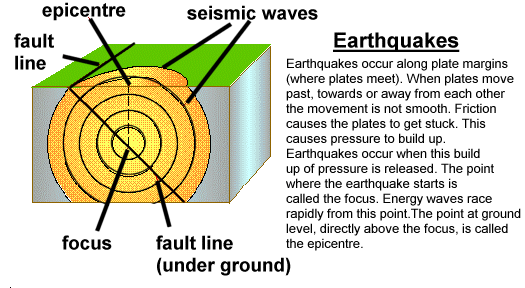
What is an earthquake and how does it occur ?

What is different between Magnitude and Intensity?
Earthquake magnitude is a measure of the size of the earthquake reflecting the energy released by the earthquake .It is represented by some real number on Richter scale say 5.8 .

Earthquake intensity indicates the extent of shaping experience at a given location due to a particular earthquake (For eg VIII on MSK scale)

It can be simply understood if we take an analogous .Consider a 60 Watt Bulb. It dissipates energy of 60 Watts. However, the brightness of light at different distances is different .In this case the former is magnitude and the latter is intensity

The Japanese use a special ‘shindo’ scale for measuring earthquakes, which is different from the more common Richter scale. Shindo refers to the intensity of an earthquake at a given location, while the Richter scale measures the magnitude – the energy an earthquake releases at the epicenter. The shindo scale ranges from shindo one (a slight earthquake felt only by people who are not moving) to shindo seven – an earthquake which causes severe damage.

How dangerous is an earthquake of magnitude 8 compared to 6 or 7 on Richter scale.
Usually an earthquake greater than 5.0 can cause strong enough ground motion to be potentially damaging to structures .Earthquakes of magnitude greater than 8.0 are often termed as great earthquake.
Log10 E= 1.5M +11.8 is the empirical equation which relates the earthquake magnitude  to the elastic energy released .By a increase in magnitude by 1 ,the energy released by the earthquake goes up by a factor of about 31 .Thus , a magnitude 8.0 earthquake releases about 31 times more energy as compared to an earthquake of 7 magnitude .

What are seismic zones?

The new earthquake zoning map of India divides India into 4 seismic zones (Zone 2, 3, 4 and 5) unlike its previous version which consisted of five or six zones for the country. According to the present zoning map, Zone 5 expects the highest level of seismicity whereas Zone 2 is associated with the lowest level of seismicity


How safe is Delhi & nearby areas from an Earthquake?

Delhi is located in seismic zone IV, the second highest earthquake hazard zone in India. Delhi has some heavily populated colonies on deep deposits of alluvium in various locations, particularly in the trans-Yamuna area. These areas are seismically vulnerable as large ground motion amplifications are expected due to their typical ground compositions. In the past, since 1720 AD, five earthquakes of Richer Magnitude of 5.5 to 6.7 are known to have occurred in the UT of Delhi or close to it. Two major lineaments, namely the Delhi-Haridwar ridge and Delhi-Moradabad faults, pass through the territory, both having a horrible potential of generating earthquakes of magnitude upto 7.0 on the Richter scale

Faridabad is more vulnerable to damage even by a moderate earthquake because they are on alluvial soil up to 200 m deep. These regions face a very grave problem of soil liquefaction during an earthquake. Moreover, earthquakes are amplified by the alluvial soils
Over 58.6 per cent of land in India is highly vulnerable to earthquakes and 38 cities fall under moderate to high risk seismic zones . Delhi, Chennai, Pune, Greater Mumbai, Kochi, Kolkata, Thiruvananthapuram, Patna, Ahmedabad, Dehradun are some of the cities falling in the vulnerability zone

To know please visit http://www.iitk.ac.in/nicee/EQTips/EQTip04.pdf


Do's & don'ts of an earthquake


I think  that it is time for us to  understand that India has high frequency of great earthquakes and low frequency of moderate earthquake .The only good thing about moderate earthquake is that they lead to improvements in construction at relatively low cost .Presently Indian earthquake problem is not receiving the due attention due to infrequent moderate earthquakes .